Edge AI Monitoring
Your model runs on the edge.
Who watches it?
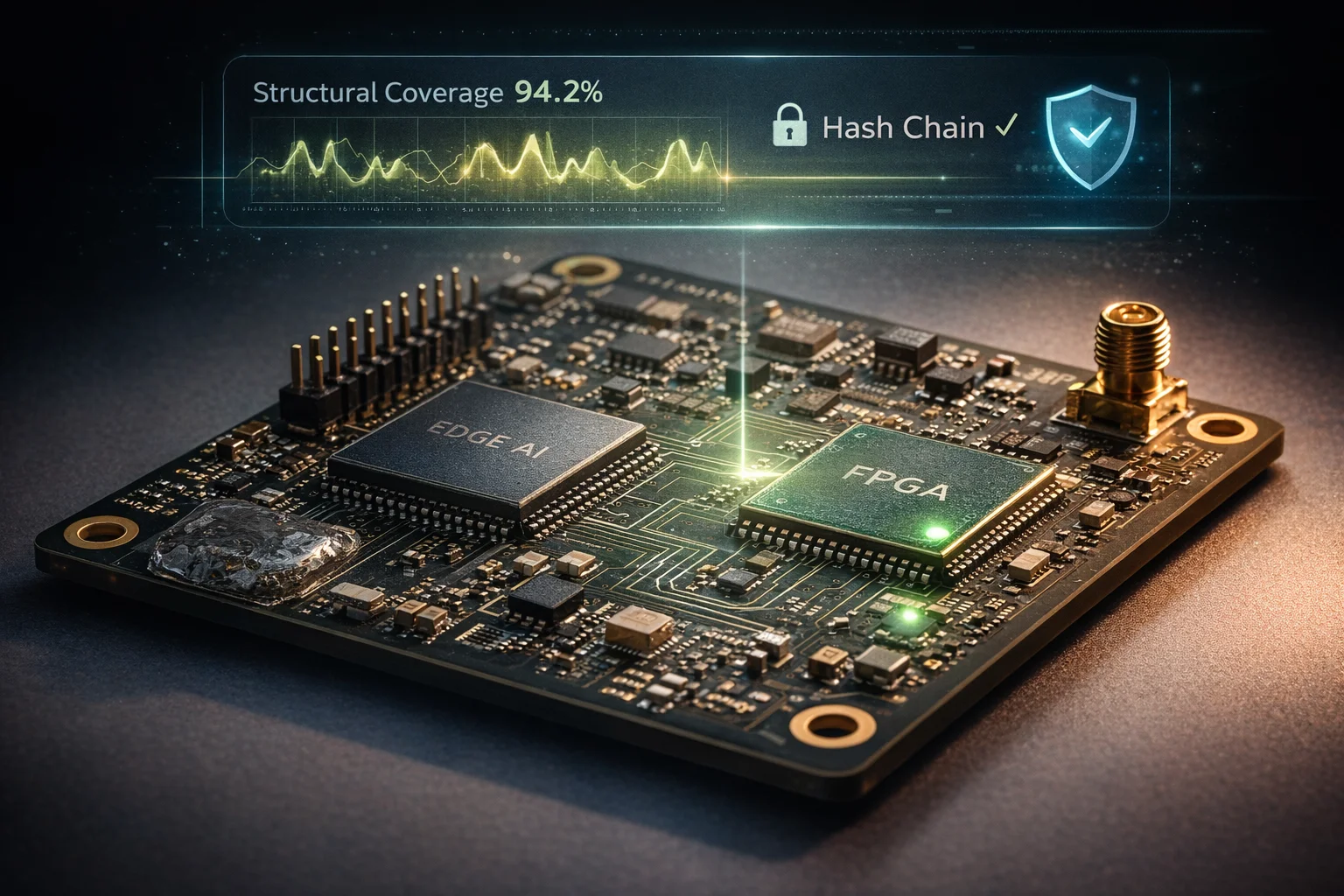
An FPGA co-processor mounted alongside your inference chip. It reads model activations during normal operation — zero CPU overhead — and runs proprietary structural analysis in under 10 microseconds. Every check is hash-chained into a tamper-proof audit trail.
If your quantized vision model stops recognizing pedestrians at dusk, you know before the next camera frame arrives.
The problem with edge AI
Quantization destroys silently
Float32 → int8 → int4. Int4 accuracy drops only 1.6% overall — but automobile recognition drops 7.3% while truck stays at 98.2%. Cosine similarity says 0.988 (fine), but 58% of retrieval rankings change. Traditional metrics miss it. Also supports ternary (BitNet), GGUF, GPTQ, AWQ. See the benchmark →
Edge means no oversight
Once deployed to a vehicle, drone, or medical device, the model runs unsupervised. No cloud connection required, no human in the loop. If it degrades, nobody knows until something goes wrong.
Regulators will mandate it
Autonomous vehicles, medical devices, defense systems — regulatory bodies are moving toward continuous AI monitoring requirements. A post-deployment audit trail will not be optional.
How it works
The FPGA sits on the same PCB as your inference chip. During normal model execution, intermediate activations are already computed and stored in memory. A DMA channel streams these to the FPGA with zero CPU overhead — the processor never pauses its main work.
What goes in
Model activations — data the inference chip already computes as part of normal operation. No extra computation, no modified model architecture, no performance impact.
What comes out
A structural coverage report: which capabilities are intact, which have degraded, and a tamper-proof audit trail that can be used for insurance, compliance, and incident forensics.
Real-world numbers
Autonomous vehicles process hundreds of camera frames per second. The FPGA handles all of them with capacity to spare.
| System | Camera FPS | Cameras | Total inferences/sec | FPGA utilization |
|---|---|---|---|---|
| Self-driving car (typical) | 36 | 8 | ~300 | <0.3% |
| AV system (high-end) | 60 | 12 | ~720 | <1% |
| Tesla FSD chip capacity | — | — | 2,300 | <3% |
| FPGA maximum capacity | — | — | 100,000+ | 100% |
At highway speed (130 km/h), a vehicle travels 1.2 meters between 30fps frames. At 60fps, that drops to 0.6 meters. The FPGA completes its structural check in under 10μs — the vehicle moves less than 0.4mm in that time.
Under 10 microseconds. Every inference.
The FPGA runs a proprietary structural analysis pipeline on each set of model activations it receives. The entire check — analysis, verification, cryptographic logging, and pass/fail decision — completes in under 10 microseconds.
Proprietary structural analysis
Activations are evaluated against a pre-deployment validation baseline using proprietary methods developed in-house.
Integrity verification
The result indicates whether the model's capabilities remain intact or if specific functions have degraded since deployment.
Tamper-proof hash chain
SHA-256 hash of the result, chained to the previous hash. Any modification to the log breaks the chain. eFUSE-signed on chip.
Hardware escalation
All clear → silent log. Degradation detected → hardware interrupt to the inference chip. Policy switch or safe halt, configurable per deployment.
Total pipeline latency: under 10μs on a mid-range FPGA at production clock speeds.
Works with any inference pipeline
Full structural analysis
When intermediate activations are accessible (most MCU and GPU inference pipelines), the FPGA performs complete structural coverage analysis — per-class, per-region, with full diagnostic detail.
Best for: MCU-based edge, GPU inference, custom accelerators with accessible memory.
Output-only drift monitoring
For sealed NPUs with fused operations where intermediate data never hits main memory, the FPGA monitors the model output distribution. Less granular, but still catches systematic drift and class collapse.
Best for: Sealed NPU packages, proprietary inference chips, output-only APIs.
AI black box recorder
Every structural check is hash-chained into a tamper-proof audit log, signed with on-chip eFUSE keys. Like a flight data recorder for AI — except it runs continuously, not just during incidents.
Compliance
Continuous audit trail for FDA, automotive safety standards, defense certification. Prove your model was monitored at every inference.
Insurance
Live structural coverage data feeds into model insurance premiums. High coverage = lower premiums. Continuous proof, not periodic audits.
Forensics
After an incident, retrieve the FPGA log. See exactly when structural coverage dropped, which classes were affected, and whether the system escalated correctly.
Target applications
Autonomous vehicles
8-12 cameras at 36-60fps. 300-720 structural checks/sec. Safety-critical, regulatory mandate coming.
Medical devices
FDA continuous monitoring requirements. Tamper-proof audit trail for surgical robots, diagnostic imaging, drug dosing.
Defense & aerospace
Air-gapped operation. No cloud dependency. eFUSE-signed logs survive EMP. Tamper-evident enclosure.
Industrial IoT
Thousands of edge devices, centralized structural monitoring dashboard. Predictive maintenance, safety systems.
Autonomous drones
Navigation, obstacle avoidance, target recognition — all running quantized models. Monitor all of them on one chip.
Robotics
Sim-to-real transfer gap monitoring in production. Catch when the real world diverges from training simulation.
Full pipeline: quantize → audit → deploy → monitor
Quantize
Compress your model — float32 → int8 → int4. Supports GPTQ, GGUF, AWQ, BitNet, or any quantization method.
Audit
Run structural coverage analysis before and after quantization. See exactly which classes and capabilities were affected.
Deploy
Flash the quantized model to your edge inference chip. Mount the FPGA monitoring module on the same PCB.
Monitor
FPGA audits every inference in real-time. Zero CPU overhead. Tamper-proof hash-chained audit log.
Insure
Continuous structural coverage data feeds into model insurance. Live premiums based on actual model health, not periodic reviews.
Interested in a pilot program?
We are looking for partners in autonomous vehicles, medical devices, and defense to co-develop the first hardware-enforced AI monitoring platform.